


Gear oil does more than just lubricate. It carries heat, shields against pressure, and keeps your drivetrain running as designed. Choosing the best gear oil means understanding your vehicle’s usage, the manufacturer’s specification, and the driving environment. From cars to tractors, and delivery vans to construction equipment, the right gear oil protects your investment and performance.
Understanding the Role of Gear Oil in Vehicle Performance
Gear oil plays a vital role in managing friction and wear between moving components. Inside a gearbox or differential, surfaces meet under high load. Without proper lubrication, this leads to scoring, pitting, and early failure.
Whether you are using car gear oil for a compact vehicle or tractor gear oil for high-load farm machinery, performance depends on film strength, thermal stability, and consistent viscosity. This is why choosing the best gear oil is not optional — it’s essential for long-term reliability.
Best Gear Oil for Cars vs. Commercial Vehicles: What’s the Difference?
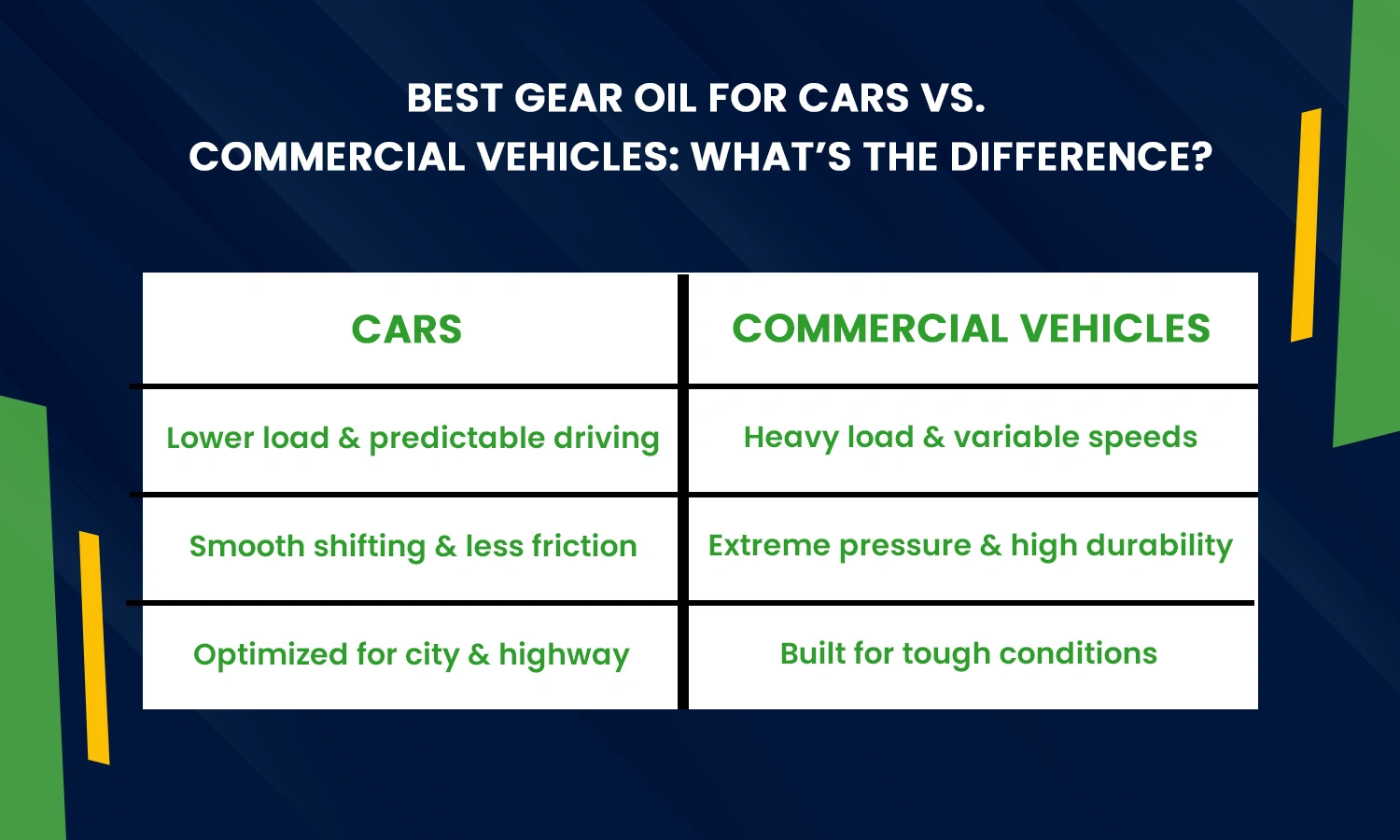
Not all gear oils are built the same. Cars generally operate under lower loads and more predictable conditions. In contrast, commercial and agricultural vehicles handle variable speeds, heavier loads, and longer service intervals.
- The best gear oil for car systems focuses on smooth shifting, reduced drag, and thermal control in urban and highway traffic
- The best gear oil for tractor or trucks prioritizes extreme pressure performance and durability under sustained load
Understanding your vehicle’s real-world usage will help you select the right oil — and avoid underperforming formulations.
How to Decode Gear Oil Grades and API GL Ratings
When choosing the best gear oil, two specs matter most — viscosity grade and performance rating.
- SAE Grades like 80W90 or 85W140 tell you how the oil flows at cold and hot temperatures
- API GL Ratings (GL-4, GL-5) tell you how much pressure the oil can handle before breaking down
The right gear oil grades depend on the transmission type and load profile. For instance:
- Use GL-4 for synchronized manual transmissions
- Use GL-5 for differentials and hypoid gear sets where load and sliding friction are high
Revia oils are available across common grades and meet international and OEM specifications.
Factors That Help You Choose the Best Gear Oil for Your Vehicle Needs
Here’s what to check when evaluating which oil suits your system:
-
Transmission Type
Is it a synchronized manual, an unsynchronized heavy-duty box, or a rear axle? -
Driving Conditions
City traffic, rural terrain, off-road load? Heat and dust affect oil breakdown. -
Load and Usage
The best gear oil for manual transmission in a hatchback will differ from what a delivery truck needs. -
OEM Spec
Always confirm the grade and GL rating required by the vehicle’s manufacturer. -
Budget vs. Reliability
Compare gear oil price points, but factor in drain interval, breakdown risk, and component protection.
Many buyers ask about the best gear oil for car in India, and the answer lies in balance — viscosity that suits the climate, additives for protection, and a reputation for quality under local road stress.
Maintenance Tips: When and How to Change Your Gear Oil Efficiently
Even the best gear oil won’t help if it’s never replaced. Here’s how to keep your system protected:
- Follow the manufacturer’s change interval — usually between 30,000 to 60,000 km for cars, more frequently for high-load use
- Inspect oil condition — check color, smell, and metal content
- Change oil before degradation sets in — burnt smell or dark color indicates heat stress
- Flush if switching viscosity or formulation — especially if upgrading from basic to synthetic
Timely maintenance ensures that every drop of oil continues to protect, especially in commercial systems where downtime costs more than the oil itself.
Key Takeaways
- Choosing the best gear oil depends on application, load, and usage
- Passenger vehicles need oil focused on smooth operation and thermal balance
- Commercial and farm systems need heavy-duty oils that resist wear under pressure
- Check both gear oil grades and API GL ratings before you decide
- Revia gear oils are engineered to deliver real performance, not just match specs
FAQs
How do I choose the right gear oil?
Match the SAE grade and API rating to your vehicle’s specs. Consider load, terrain, and service interval before choosing.
What type of gear oil is used in cars?
Most cars use 75W90 or 80W90 with a GL-4 rating, depending on the transmission type. Always check the OEM manual.
How do you check gear oil quality?
Look at the oil’s color and smell. Fresh oil is golden or amber. If it’s dark, gritty, or smells burnt, it needs replacing.
Which gear oil is best for heavy vehicles?
The best gear oil in India for heavy vehicles is one that offers high film strength, thermal stability, and GL-5 protection. Revia 85W140 is one such grade built for Indian conditions.